
Stacking Vermicompost Worm Bin Tower Plan
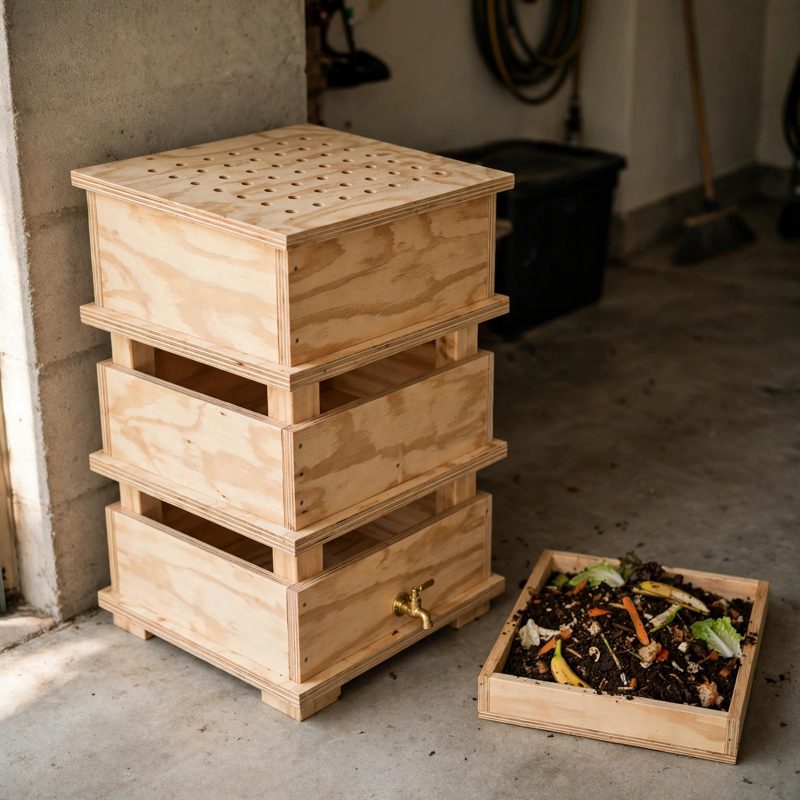
Top-of-the-line, above and beyond the old style - safer by design, and every claim below names a real feature drawn into the plan itself.
THE BUILD: a stacking vermicompost worm bin tower, 28 x 20 in footprint and 36-3/4 in tall, with three working trays (24 x 16 x 8 in each, 9.3 gal working volume) hung by their rim flanges on wooden ledges, a base reservoir tray with a spigot for draining liquid, and a vented plywood lid - an indoor/garage red-wiggler system for kitchen scraps. This is NOT the outdoor 3-bin compost system in the same catalog: that is a yard-scale hot-compost build for leaves and grass; this tower is a small-footprint worm system with tray rotation and liquid capture.
BETTER BECAUSE THE FAILURE MODES ARE DESIGNED AGAINST: (1) A TRAY THAT CANNOT DROP - a finished tray of wet castings weighs about 58 lb, computed two ways in the plan (56.1 lb by bulk density, 56 lb by component sum, design load 60 lb); every tray bears on 44 sq in of ledge (1 in of flange width x 22 in per long side), every ledge rail rests on bearing cleats screwed to the legs, and the plan load-tests every level at 60 lb of water weight before worms go in. No tray or rail hangs on screws alone. (2) FLIES AND GNATS DESIGNED OUT - food is always buried 2 in under bedding, a damp bedding-cover sheet caps every tray, and every vent is small (1/4 in tray vents, two 2 in lid vents) and screened with fine mesh under 1 mm. (3) NO DROWNED BIN - each tray drains through a 28-hole, 1/4 in grid into the tray below and into the spigoted base (bulkhead fitted 1 in above the floor, gaskets both sides, one-hour leak test in the steps). (4) HONEST LIQUID - the plan defines leachate and compost tea separately and states plainly that the spigot produces leachate, NOT tea: dilute 10:1 for ornamentals or send it to outdoor compost. (5) HONEST ODOR - a fed-right bin smells earthy; an overfed one smells sour, and the plan uses that as the feeding gauge instead of promising no smell ever.
BEGINNER-FIRST, IN DEPTH: terms defined at first use (vermicompost, bedding, castings, leachate vs compost tea, rim flange, ledge/cleat, migration harvest, grit), practice-first tote-fit, cleat-joint and drilling exercises, 28 continuously numbered steps in 6 stages, 12 labeled diagrams, a stop-and-check after every stage, mistake fixes (fruit flies, fungus gnats, sour bin, climbing worms, plugged drainage, cracked rims), and a full operations section: starting the bin, worm quantity from tray surface (2.14 sq ft, about 2 lb capacity per tray at the standard 1 lb per sq ft rule of thumb, labeled as a rule of thumb; system starts with 1 lb), feeding rates (about 2-3 lb of scraps per week per lb of worms, only when the last feeding is mostly gone), and harvest by migration to the next tray. Worm sourcing names the species - red wigglers, Eisenia fetida, NOT nightcrawlers - with costs labeled estimates. No harvest rate or timeline is promised anywhere: trays finish in months at the colony's pace.
You receive: the PDF plan only (digital download, no physical product ships) with cut list, materials list with good/better paths (pine vs cedar frame, plastic vs brass spigot, standard vs certified food-grade totes), full two-way verification section, and final checklist. Full build plans and material list in the TheWorkshopBlueprint website store at theworkshopblueprint.shop.