
Wall-Mounted Drop-Leaf Dining Table Plan - Seats 4, Folds Flat
Not a standard off-grid kit - top-of-the-line, above and beyond the old style - safer by design, and every claim below names a real feature drawn into the plan itself.
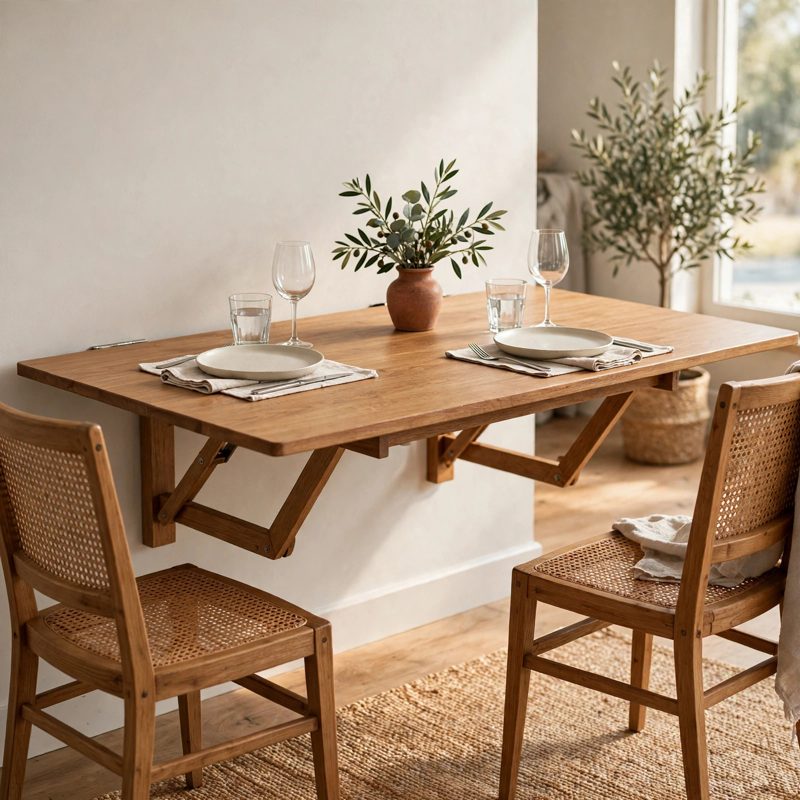
THE BUILD: a wall-mounted drop-leaf DINING table - not a desk - with a 48 x 36 in top at 30 in dining height that seats four (two per long side, 24 in of table length each). The top is a fixed centre panel 48 x 16 in plus two drop leaves 48 x 10 in each, hinged at rule joints. It folds to a 5-3/4 in profile off the wall (about 6 in). The catalog's fold-down wall desk is a single work panel for one person; this is a four-person dining table on a 200 lb dining design load, with swing-out gate leg frames under the leaves - different size, different structure, different load.
SAFER BY DESIGN - THE WALL-TABLE FAILURES ARE DESIGNED AGAINST: (1) WALL PULLOUT is answered with a 42 x 5-1/2 x 1-1/2 in ledger lagged into three wall studs with six 3/8 x 5 in lag screws at 3 in of bite each - and a printed stud gate: every pilot is probed for solid stud wood before any lag is driven, the build stops if a stud is missed, and drywall anchors are refused outright with no anchor fallback anywhere in the plan. (2) A LEAF DROPPING UNDER LOAD is designed against three ways: each leaf bears on a swing-out gate leg frame whose top rail sits under the leaf's centre of gravity (5 in out from the hinge line), so the gate carries the leaf and the hinge carries pivot only; each gate has a stop block and a gravity latch that must click shut; and a printed leaf-support check runs before the proof test and before every use. (3) PINCH INJURIES are answered with rule joints at both leaf hinges (no scissoring gap), a two-hand fold sequence with hands only on the leaf outer aprons - the named grip zones - never within 4 in of a hinge line, and a printed adults-only folding rule. (4) HINGE TEAR-OUT is answered with 48 in continuous piano hinges screwed into the panel faces, with the #6 x 5/8 in screw specified precisely because a 3/4 in screw was reach-checked and rejected - its tip would break the top face. (5) FAR-END RACKING is answered with a fold-down end leg frame locked at 90 degrees by two folding stays, gated by a sideways push test (1/4 in or less) before and after the proof test.
EVERY MEASUREMENT VERIFIED TWO WAYS: open width by the parts chain (leaf 10 + centre 16 + leaf 10 = 36 in) and by taping the assembled top (36 in, centre 16, remainder 10 per leaf); length by the panels (48 in) and by gate coverage (36 in gate + 6 in cantilever each end = 48 in); height by frame plus top (29-1/4 + 3/4 = 30 in) and by the ledger line set at 29-1/4 in plus the 3/4 in panel; folded depth by the full stack (ledger 1-1/2 + folded end frame 1-1/2 + centre 3/4 + two leaves 1-1/2 + offsets 1/2 = 5-3/4 in) and by grouped sums (wall-side 3 in + top group 2-1/4 in + offsets 1/2 in = 5-3/4 in); ledger capacity by totals (six lags at a conservative 150 lb planning value = 900 lb against a 130 lb ledger demand, about 7x) and per lag (about 22 lb demand against 150 lb); leaf load by gate-rail bending (about 67 psi at the 50 lb design leaf load) and by leg compression (about 11 psi). Every fastener is reach-checked in the plan, including the rejected longer hinge screw.
BEGINNER-FIRST, IN DEPTH: every term defined at first use (ledger, drop leaf, gate leg frame, rule joint, bite, bearing, centre of gravity, proof test), a practice-first stage proving the lag pilot drive, the 5/8 in hinge-screw proof, and the fold sequence on scrap, 26 continuously numbered steps in 6 stages, 12 labelled diagrams placed at their steps, a stop-and-check after every stage (probed stud gate, rule-joint straightedge test, assembled top taped at 48 x 36, gate latch checks, folded stack taped, 200 lb proof test held 10 minutes with a 1/8 in sag limit), mistake fixes (a missed stud, a stepping leaf, a rocking leaf, centre sag, far-end sway, a lifted screw tip, an over-thick folded stack, a stiff gate), a good/better materials path (birch plywood and pine vs a solid-edge top, stainless hinges and lags, and hardwood frames - the upgrades that genuinely matter at a dining table), and sourcing with exactly what to order including the sheet-yield math (the whole 12 sq ft top plus aprons from one 4 x 8 sheet), costs labelled estimates totalling $140-$235. The 200 lb proof test is a step in the plan, not a claim in the copy: 50 lb per leaf plus 100 lb on the centre, loaded in quarters, held 10 minutes, then re-inspected.
You receive: the PDF plan only (digital download, no physical product ships) with cut list, materials list, full two-way verification section, and final completion checklist. Full build plans and material list in the TheWorkshopBlueprint website store at theworkshopblueprint.shop.