
Large Solar Food Dehydrator Plan
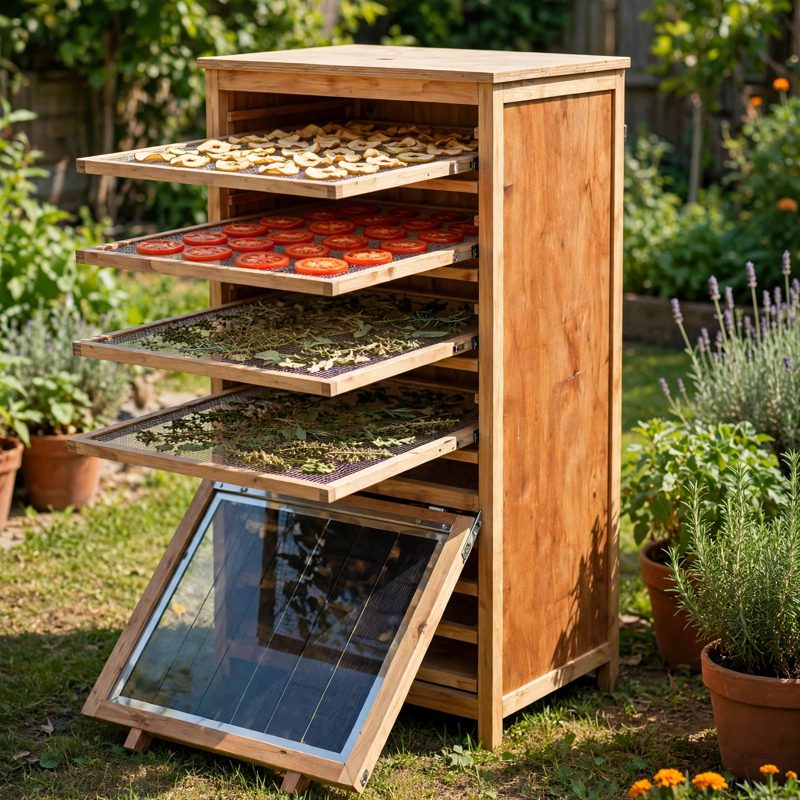
Not a standard off-grid kit. This is the top-of-the-line rebuild of the solar food dehydrator - the version that actually dries evenly, with every claim below naming a real feature drawn into the plan itself.
THE BUILD: a 48 x 72 in glazed collector at a fixed 35 degree tilt feeding a 10-tray cabinet - 51.9 sq ft of USABLE drying screen (the honest net figure; listings usually quote the 60 sq ft gross).
WHAT ORDINARY BLACK-BOX PLANS LEAVE OUT, ALL DRAWN IN: (1) SIZED VENT AREAS, NOT GUESSES - intake free area 113 sq in at the collector foot, exhaust 128 sq in at the cabinet top, both in the same screen spec so the exhaust stays ahead of the intake by 1.13x however you count it. (2) A BAFFLE PLENUM TUNED BY MEASUREMENT - collector air is spread across the full cabinet width and proven with a five-point tissue test at the bottom and top trays before any food goes in; the tuned baffle setting is written on the plenum. (3) A SOLAR FAN ASSIST for the still, hazy hours when thermal draft fades and mold starts - it runs on its own small panel exactly when the sun works, no battery, and the plan claims it as an assist, never the prime mover. (4) AN HONEST HUMIDITY DERATING - in humid climates you load 6-8 trays instead of 10, improving the collector-to-tray ratio from 0.46 to 0.58-0.66 (shown in the verification math) so batches finish in a day instead of straddling a damp night.
EVERY MEASUREMENT VERIFIED TWO WAYS: drying area (34 x 22 in net per tray; gross-minus-frame agrees at 51.9 sq ft), tray stack (10 x 4 + 6 + 6 = 52 in, checked against the cleat layout), collector geometry (72 in at 35 degrees = 41.3 in rise and 59.0 in footprint, closed by Pythagoras at exactly 72.0), vent free areas, tray lumber tally, and every fastener bite-checked (cleat screws bite 1.0 in into the cabinet's side framing through the skin - which is why the sides are framed, not bare plywood) with every tray bearing ON its cleats.
BEGINNER-FIRST, IN DEPTH: terms defined at first use (collector, plenum, baffle, free area, case hardening), practice first (one complete tray load-tested, screen tension judged by a sag test, the site's sun mapped at three hours), 29 continuously numbered steps, 12 labeled diagrams, a stop-and-check after each of the 8 stages, mistake fixes for every stage, NCHFP drying temperatures and the separate USDA jerky heat step (160 F / 165 F) kept distinct from drying, conditioning and storage protocol, sourcing with a good/better path (food-safe screen is non-negotiable - never galvanized or fiberglass in the food path) and costs labeled estimates, and a final checklist.
You receive: the PDF plan only (digital download, no physical product ships) with materials list, cut list, full verification section, tilt worksheet, and the door-card rotation schedule. Full build plans and material list in the TheWorkshopBlueprint website store at theworkshopblueprint.shop.