
Sawbuck X-Frame Firewood Cutting Stand Plan
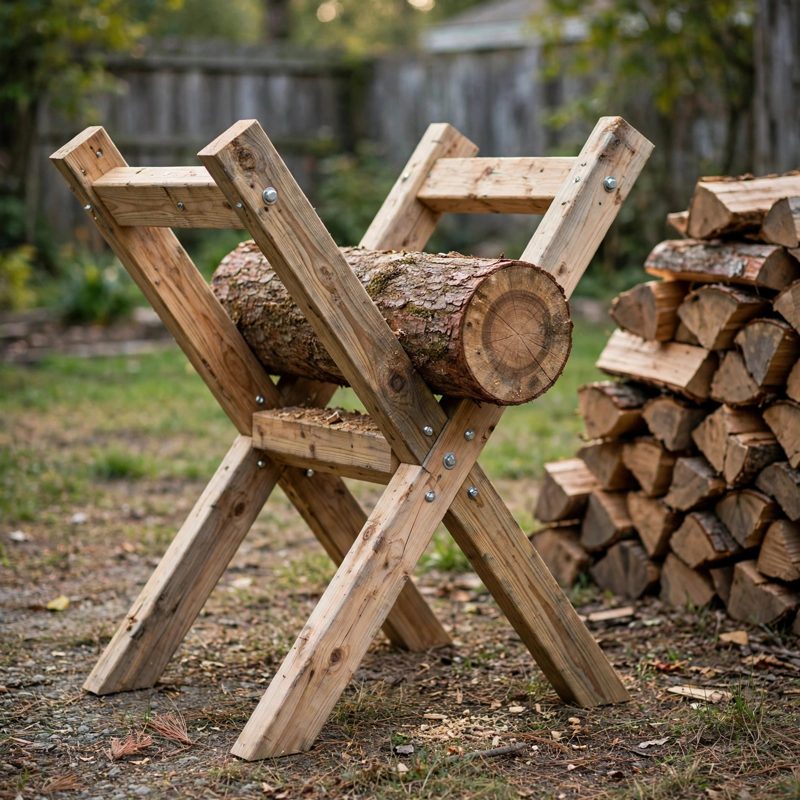
Not a standard off-grid kit - top-of-the-line, above and beyond the old style - safer by design, and every claim below names a real feature drawn into the plan itself.
THE BUILD: a fixed X-frame sawbuck (log holder) for bucking firewood, 31-3/16 in tall, built from three ordinary 2x4 boards - four 36 in legs in two X-frames spaced 36 in apart, joined by two 42 in side rails, with a fitted log stop. Nothing folds, nothing is bought as a kit, and every part is home-centre stock.
THE LOG CANNOT ROLL OUT - TESTED, NOT ASSERTED: the legs cross at a full 60-degree included angle so a log nests in two deep V-cradles at two stations 36 in apart, and the build is gated by a mandatory numbered roll test - a real 8 to 12 in round spanning both frames, pushed hard both ways, must rock and settle back or the stand does not pass. A log stop fitted at one frame stops lengthwise creep, and the plan states the honest corollary: a log that rolls out under the test is cut by another method.
THE SAW CANNOT FIND THE STAND: cut zones are measured and painted on the rails during the build - cuts only between the frames (33 in clear) or on an overhang, always at least 6 in from any leg, rail, bolt, or screw, never over a frame. The pivot bolts sit 18-3/16 in above the ground while a cradled log's underside sits about 20 in or more up, so a chain finishing a legal cut exits into open air. The top 3 in of each leg is a painted sacrificial zone with a printed inspection rule (a nick is watched; a cut deeper than 1/2 in retires the leg, and the replacement procedure is in the plan).
HONEST CAPACITY, THREE LIMITS, MATH TWO WAYS: diameter 4 to 16 in - proved from the cradle geometry (a 16 in log contacts the leg at 13.9 in along the 15 in top segment; an 18 in log would contact at 15.6 in, past the tip, and is refused in print). Length 42 to 72 in - the log must span both frames (36 + 3 + 3) and may overhang 18 in per end (36 + 18 + 18). Weight 200 lb maximum - with a worked worksheet: a 12 in x 48 in log is 157 lb computed by volume AND by the running foot, and the plan shows the trap in numbers: a 16 in x 36 in green oak log is about 260 lb and is OVER the limit despite passing diameter and length. The finished stand is then load-tested at the full 200 lb for ten minutes in a numbered step, with tape numbers re-read after.
GEOMETRY THAT CLOSES THREE WAYS: each leg is 36 in, pivot hole at 21 in (21 + 15 = 36), splayed 30 degrees from vertical. Height 31-3/16 in comes out of the trigonometry (36 x cos 30) AND out of the segment sum (18-3/16 + 13 = 31-3/16); foot spread 21 in and top spread 15 in come out of the splay AND sum to the leg's 18 in horizontal travel; and Pythagoras on the height and travel returns the leg at exactly 36.0 in. All three readings are then gated by tape on the assembled frames, and the pair of frames must match each other within 1/4 in.
FASTENERS WITH CHECKED REACH: each pivot is one 3/8 x 4 in through bolt - 3.0 in of wood stack plus washers and nut totals 3.47 in, leaving about 1/2 in of thread showing, with a two-thread minimum gated in a practice-first stage on scrap. Rail joints use two #10 x 3 in screws each: 1-1/2 in through the rail, 1-1/2 in of bite into the leg, tip stopping 2 in short of the far face so no point can ever reach the cradle or the log.
BEGINNER-FIRST, IN DEPTH: every term defined at first use (sawbuck, cradle, splay, pivot bolt, bite, bearing, kerf, binding, sacrificial zone, cut zone, log stop), a practice-first stage proving the pivot joint on offcuts, 28 continuously numbered steps in 7 stages, 12 labelled diagrams placed at their steps, a stop-and-check after every stage, mistake fixes (split pivot hole, mismatched frames, screw poke-through, a rolling log, a closing kerf, a deep tip nick, loosening nuts), a full Using the Stand section on reading the kerf and wedging binding with a plastic wedge, good/better materials (pine vs pressure-treated or fir; zinc vs galvanised/stainless with nyloc nuts), and sourcing with the three-board yield math (228 in used + 60 in leftover = 288 in bought) and costs labelled estimates totalling $35-$60 good / $55-$90 better.
You receive: the PDF plan only (digital download, no physical product ships) with cut list, materials list, full two-way verification section, and final completion checklist. Full build plans and material list in the TheWorkshopBlueprint website store at theworkshopblueprint.shop.