
Portable Sheep & Goat Mineral Feeder Plan - Skid-Mounted, 2-Compartment with Rain Hood
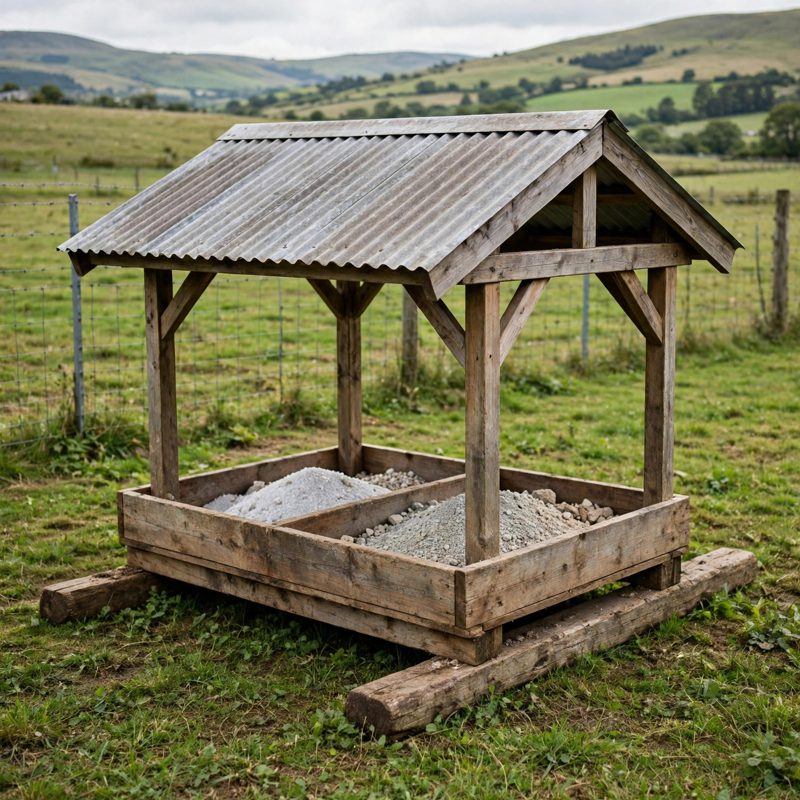
Not a standard off-grid kit - top-of-the-line, above and beyond the old style - safer by design, and every claim below names a real feature drawn into the plan itself.
THE BUILD: a portable sheep and goat mineral feeder station, 48 x 24 in skid base, with a low divided tray (rim 11-1/4 in above the ground), two compartments - a 26 in loose-mineral compartment and a 15-3/4 in baking-soda compartment, each 18-1/2 in wide inside - and a fixed sloped rain hood on four posts (top 30-1/2 in at the front, 26-1/2 in at the back) that sheds rain off the back, away from the main feeding side. This station feeds LOOSE MINERALS, not hay: it is not a hay rack and not a milking stand - it is the free-choice mineral and baking-soda point for a flock or herd, built low for sheep and goats, divided because the two feeds are offered separately, hooded because loose mineral cakes and is wasted when rain reaches it, and skid-mounted because a feeder that cannot move turns its own pen corner to mud.
SAFER BY DESIGN - THE MINERAL FEEDER FAILURES ARE DESIGNED AGAINST: (1) WET, RUINED MINERAL is answered with a solid hood roof overhanging the tray about 4 in at each end and about 3-3/4 in at each side, a 4 in front-to-back slope that drips behind the station, and a printed working fill line 1 in below the rim so the fill surface sits sheltered inside the tray - plus a printed rule to break up any caked crust the day after a storm. (2) FEED AGAINST TREATED LUMBER is designed out: the tray walls, divider, and bottom are untreated lumber only, each compartment gets a removable food-grade liner cut to a worked size (31 x 23-1/2 in and 20-3/4 x 23-1/2 in) so feed rests on the liner, and the only pressure-treated parts in the build are the two ground-contact skids, separated from the feed by the deck slats and the tray bottom. (3) TIPPING AND RUBBING are answered with numbers printed in the plan: a 24 in wide low base that takes about 75 lb of sideways push at the tray rim to tip empty and about 144 lb loaded, a tilt of about 39 degrees empty and 45 degrees loaded before it can go over, and posts that bear on deck slats directly over the skids so a rub pushes into the strongest part of the base. (4) SHARP EDGES AND PINCH POINTS are answered with a fixed hood that never hinges or slams, every in-tray screw reach-checked so no tip can exit into a compartment, tray-to-deck screw heads that live under the liners, and a gated gloved-hand check over every edge an animal can reach. (5) DRAGGING INJURIES are answered with two tow eyes set low in the skid ends (about 3 in above the ground) and a bridle: the plan works the loaded drag at about 68 lb of pull with an 8-to-1 tip margin, and shows the same pull at the hood top would tip the station - never tow by the hood, in numbers. (6) THE WRONG MINERAL FOR THE SPECIES is named in Safety First and gated at the first fill and at every new bag: sheep are highly sensitive to copper and many goat minerals carry copper levels unsafe for sheep, so the plan directs the builder to a product labelled for the species actually kept and makes no animal-health or intake claims anywhere.
EVERY MEASUREMENT VERIFIED TWO WAYS: overall length by the skid (48 in) and by the tray chain (2 in inset + 44 in tray + 2 in inset = 48 in), confirmed again by the deck slat centres (6 + 36 + 6 = 48 in); width by the skid stack (1-1/2 + 21 + 1-1/2 = 24 in) and by the 24 in deck slats; tray interior by the wall stack (44 - 3/4 - 3/4 = 42-1/2 in) and by the compartment chain (26 + 3/4 + 15-3/4 = 42-1/2 in); capacity by per-compartment volume (mineral 26 x 18-1/2 x 2-1/2 = 1,202.5 cu in; soda 728.4 cu in) and by whole-interior-minus-divider (1,965.6 - 34.7 = 1,930.9 cu in total); rim height by the full stack (5-1/2 + 1-1/2 + 3/4 + 3-1/2 = 11-1/4 in) and by deck-top-plus-tray grouping (7 + 4-1/4 = 11-1/4 in); hood heights and head clearance by post stacks and by the 4 in post difference; roof coverage by panel-minus-tray and by slope geometry. Weights from bulk density are labelled ESTIMATES wherever they appear: the mineral compartment at working fill holds about 48-60 lb (about one standard 50 lb bag), the soda compartment at its recommended 1 in fill about 9-11 lb. Every fastener is reach-checked, including the two places a longer screw fails: roof-to-batten screws are a deliberate #8 x 1-1/4 in (1/2 in bite, tip 1/4 in short) because a 1-5/8 in screw would exit the batten under the roof, and tray-to-deck screws stop 1/4 in short of the slat underside.
BEGINNER-FIRST, IN DEPTH: every term defined at first use (loose mineral, free-choice, skid, chamfer, deck slat, divider, freeboard, hood, batten, bearing, bite, tow eye, bridle, liner, bulk density), a practice-first stage proving the pilot-and-bite joint, the 42-1/2 in tray tape layout, and the 45-degree skid chamfer on scrap, 24 continuously numbered steps in 6 stages, 12 labelled diagrams placed at their steps, a stop-and-check after every stage (base diagonals equal, compartments taped with the chain closing, rim height taped at four corners, roof overhangs taped, gloved-hand edge check, bucket water test shedding off the back, empty and loaded drags proven), mistake fixes (an off-size compartment, an interior that does not tape 42-1/2 in, a feelable screw tip, a roof dripping on the feeding side, caked mineral under the hood, a rocking station, a goat standing in the tray, a torn liner), a good/better materials path (pine and coated hardware vs cedar tray parts, stainless fasteners, a flashing roof cap, and a spare liner set - the upgrades that genuinely matter on a feeder that lives outdoors in a pen), and sourcing with exactly what to order including the lumber yield math for every board and the single plywood sheet that yields both roof and tray bottom, costs labelled estimates totalling $105-$185. Finished station weight is stated honestly two ways at about 70 lb empty and about 135 lb loaded, with the drag and tip math printed in the open.
You receive: the PDF plan only (digital download, no physical product ships) with cut list, materials list, full two-way verification section, and final completion checklist. Full build plans and material list in the TheWorkshopBlueprint website store at theworkshopblueprint.shop.