Indoor Firewood Log Rack with Kindling Shelf Plan
Not a standard off-grid kit - top-of-the-line, above and beyond the old style - safer by design, and every claim below names a real feature drawn into the plan itself.
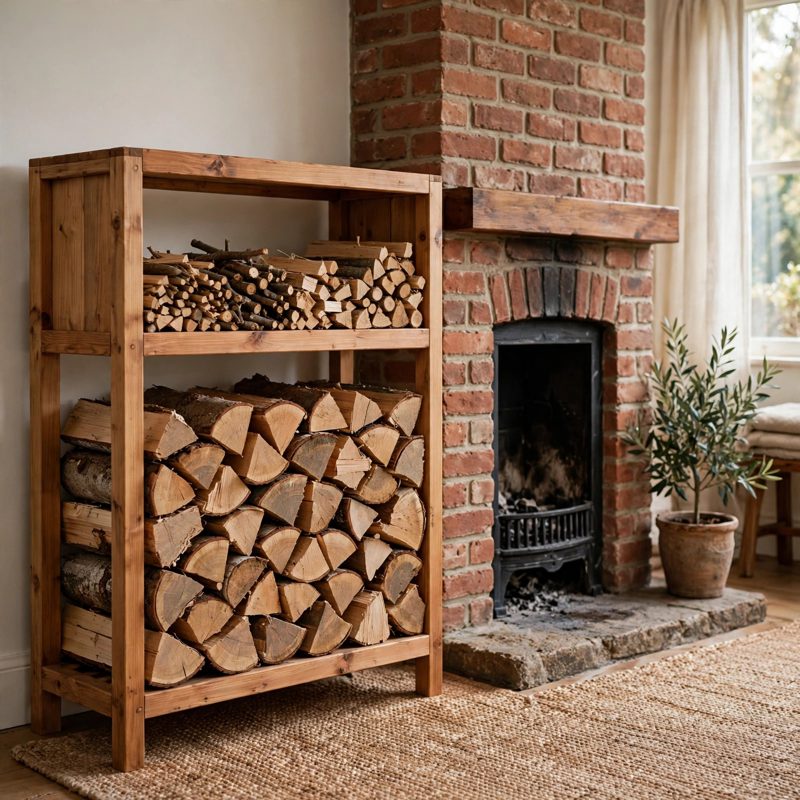
THE BUILD: an indoor firewood log rack, 48 in wide x 20 in deep x 32 in high, with a main log bay 45 x 17 in with 21 in of clear stack height and a separate kindling shelf above a solid divider. Logs lie front to back: a standard 16 in log in the 17 in interior depth keeps 1/2 in of clearance at each end (1/2 + 16 + 1/2 = 17, worked in the plan). Stack volume is 9.30 cu ft worked two ways - interior box (45 x 17 x 21 = 16,065 cu in) and face-cord math (3.75 ft face width x 1.75 ft height x 1.4167 ft depth) - and stated honestly: that is about 44% of a 4 x 4 ft face cord at 16 in logs (21.3 cu ft), a few days of indoor burning, not a quarter cord by volume (a quarter cord is 32 cu ft and no living-room rack this size holds it; the name refers to the face class). This is indoor furniture for wood you are about to burn - different from this shop's outdoor 8-ft firewood rack (ground-contact bulk storage, no floor protection or kindling shelf) and its roofed 4x8 firewood shed (a roofed outdoor season store).
SAFER BY DESIGN - SIZED FOR GREEN WOOD, NOT SEASONED OPTIMISM: the design load is worked from a stated density - green mixed hardwood at about 50 lb per cu ft of stack x 9.30 cu ft = about 465 lb of wood, plus about 34 lb of rack (lumber volume 2,371 cu in at about 25 lb per cu ft, also summed per part in the plan) = a 500 lb design load, against about 325 lb for the same stack seasoned at about 35 lb per cu ft. Six posts, not four: the two centre posts halve every front and back base rail span from 45 in to about 22-1/2 in, base slats bear 1-1/2 in on dimensioned rails at both ends, shelf boards bear on end rails plus a centre support that halves their span to about 21-3/4 in, and a counted 24-hour load test at about 325 lb is a numbered step before any green load.
STATIONARY ON PURPOSE, FLOOR-SAFE BY DESIGN: no casters are offered - a 500 lb loaded rack on small wheels dents floors and rolls when a log shifts - so the plan places the rack empty on six felt/rubber floor-protection pads (about 83 lb per foot at design load), raises the log platform to 5-3/4 in, spaces the nine base slats with 1-11/16 in gaps (9 x 3-1/2 in of wood + 8 gaps = the 45 in width, two-way checked) so bark falls through, and slides a bought bark and debris tray (about 40 x 16 in, max 3 in high) into the 3-1/2 in tray zone underneath to catch it.
KINDLING SEPARATE, PLACEMENT HONEST: three solid divider boards form the log bay's top and the kindling shelf's floor, so kindling is never buried in the log pile; retaining depth above the shelf is 4-1/2 in to the top rails. On placement the plan invents nothing: it prints no safe-distance number of its own and makes it a numbered step to place the rack no closer than the larger of your stove maker's printed clearance to combustibles and your local fire code, tape-measured, with a cool-to-the-touch check at full burn. Indoor use rules are printed as steps: only a few days of wood indoors, burn in rotation from the outdoor store, no wet or icy wood, tray brushed weekly, monthly insect check.
BEGINNER-FIRST, IN DEPTH: every term defined at first use (log bay, divider shelf, bite, stack volume, face cord, seasoned vs green, clearance to combustibles, tray zone), a practice-first stage proving the piloted frame joint at 1 in of bite, building the slat-spacing gauge, and filling a worksheet (measured log length, density and load sum, stove clearance), 24 continuously numbered steps in 6 stages, 12 labelled diagrams placed at their steps, a stop-and-check after every stage, mistake fixes (a sagging rail, rolling logs, over-length wood, a rocking rack, a jammed tray, kindling in the bay, a spinning screw, a warm stove-side face), good/better materials (pine vs clear stock, zinc vs coated screws, felt vs rubber-and-felt pads, plain vs lipped metal tray), and sourcing with exactly what to order - including lumber yield math (eight 2x2 x 8 ft cross-checked as 6 posts + 6 long rails + 7 short pieces) - with costs labelled estimates totalling $110-$175. Every fastener is reach-checked in the plan: frame screws #8 x 2-1/2 in bite 1 in, slat and shelf screws #8 x 1-3/4 in bite 1 in, mid-slat screws #8 x 2 in bite 1-1/4 in, no tip through any far face.
You receive: the PDF plan only (digital download, no physical product ships) with cut list, materials list, worksheet, full two-way verification section, and final completion checklist. Full build plans and material list in the TheWorkshopBlueprint website store at theworkshopblueprint.shop.