
Hall Tree Coat Bench Plan
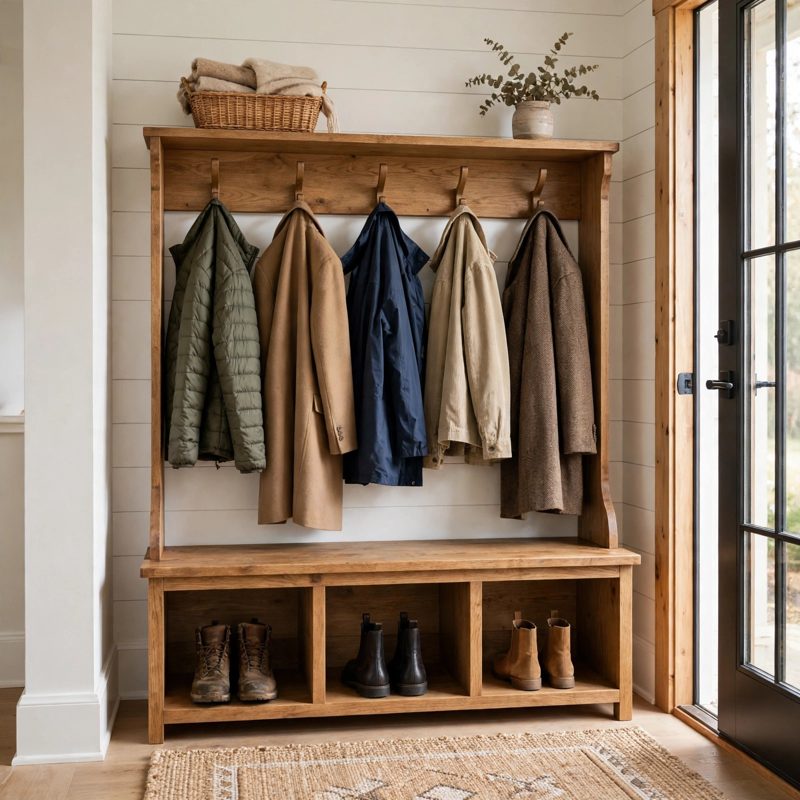
Build a hall tree with bench, coat hooks and top shelf: 48 x 18 x 72 inches - a bench seat for two adults at 18 inches high, five double coat hooks on a solid hook board, a top shelf at 66 inches, and two open shoe cubbies with a raised shoe shelf (13 inches of boot clearance) in one entryway footprint.
The structure is engineered in bearing, not hope: the bench seat rests ON cleats screwed to the two full-height side uprights AND ON two center legs standing on the floor (35-1/4 square inches of bearing; a 500 lb design load - two 250 lb adults - works out to about 14.8 lb per square inch), the back panel rests ON the seat, the top shelf rests ON its own cleats, the upper back panel rests ON the top shelf, and the top cap rests ON the uprights. Every load travels straight down through wood to the floor.
Tip safety is a build stage of its own, because a 72 inch tall, 18 inch deep unit is a real tip hazard: the plan works the tip math in the open (an unanchored unit could be pulled over by about 21 lb of pull at hook height) and specifies two steel angle brackets screwed down into the top cap and into wall studs with #10 x 3 inch screws (2-3/8 inches of bite in solid stud), plus a 50 lb pull test at the hooks that must pass before the unit is used - and again after the load tests. Anchoring is required, never optional, and drywall anchors are never a substitute.
Hooks are engineered too: each of the five double hooks screws through its steel base into a 1-1/2 inch stack of solid hook board plus back panel (1-3/16 inches of screw grip, tip 5/16 inch short of the back face), the hooks sit on an exact chain of six equal 7-3/4 inch intervals across the 46-1/2 inch interior, and the design hook load is 200 lb (40 lb per hook), proved with all five hooks loaded at once for ten minutes.
This is a beginner-first plan, not a one-page cut list. Every term is defined at first use (bearing, cleat, bite, stud, anti-tip anchor, hook board), you practice the cleat bearing test, the hook-screw stack under a 40 lb hang test, stud-finding, and the upright edge joint on scrap first, and every technique step has its own labeled diagram (12 illustrations), a stop-and-check checkpoint after each stage, fixes for the common mistakes, and a final checklist. All math is shown two ways: the height stack 18 + 47-1/4 + 3/4 + 5-1/4 + 3/4 = 72 inches, the width chain 3/4 + 46-1/2 + 3/4 = 48 inches, the cubby chain 22-1/2 + 1-1/2 + 22-1/2 = 46-1/2 inches, the hook chain 6 x 7-3/4 = 46-1/2 inches, and a bite check for every screw in the build.
You receive: a PDF plan with cut list, materials list, tool list, 38 continuously numbered steps, 12 diagram figures, full measurement verification (dimension chains, plywood layout chains, every fastener's bite, bearing areas, bench load, hook load, and the tip calculation), a one-hour 500 lb bench load test, a 200 lb hook load test, a 50 lb anchor pull test, mistake fixes, and a final checklist, plus a materials estimate of $195-$255.
DIGITAL DOWNLOAD: this listing is for the PDF building plan only. No physical product will be shipped. Print it or build from a tablet in the shop.
Full build plans and material list in the TheWorkshopBlueprint Etsy shop.