
Folding TV Tray Table Set of 4 Plan with Storage Stand
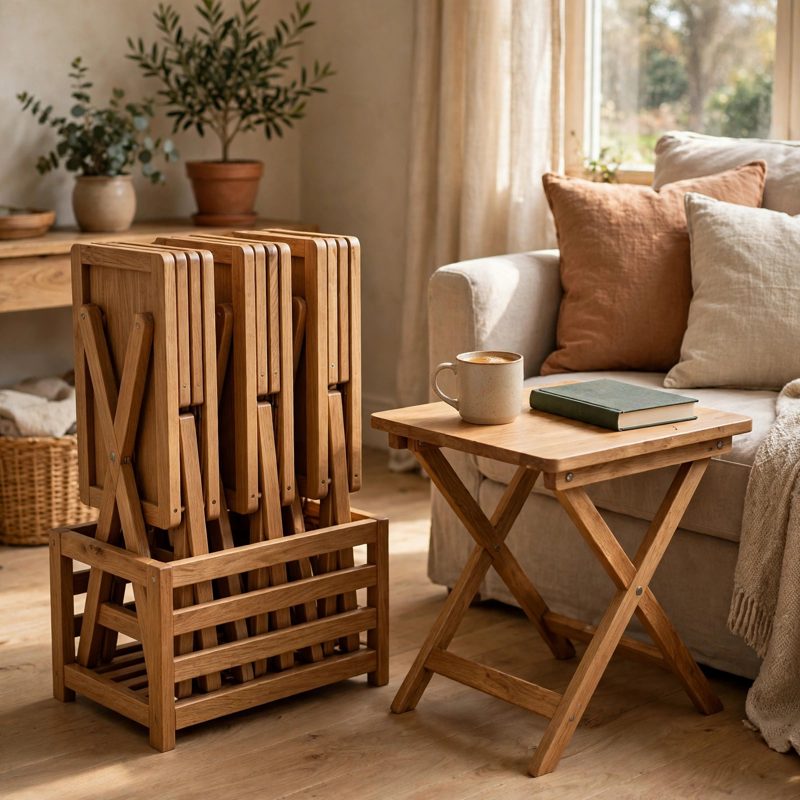
Not a standard off-grid kit - top-of-the-line, above and beyond the old style - safer by design, and every claim below names a real feature drawn into the plan itself.
THE BUILD: a set of four identical folding TV tray tables plus the storage stand that holds all four upright. Each tray: 19 x 14-1/2 in top, 26 in tall open, folding flat to a 2-1/2 in slab. The stand is 21-1/2 x 12-1/2 x 16-3/4 in with four divided slots. Working load is stated in the open: 25 lb per tray, centred, proof-tested in the plan at 50 lb per tray before first use. All sixteen legs in the set are the same part, marked from one full-size template.
SAFER BY DESIGN - THE TRAY FAILURES ARE DESIGNED AGAINST: (1) X-LEG RACKING - the wobble that ends with a tray folding under a hot meal - is answered with a locking pivot spreader on each side of each tray: a two-piece hinged link (two 2-3/4 in halves spanning 5-1/2 in locked), bolted 6 in below the pivot, that locks straight on a stop pin and holds the X at its exact working angle. (2) PIVOT LOOSENING is designed against with a 3/8 in through-bolt on each side with washers on both faces and a nylon lock nut - never a screw into end grain - plus a printed re-check of every nut after the proof tests. (3) TIP-OVER WITH A LOADED TRAY is answered with geometry, not hope: the footprint is 14-3/4 in deep, deeper than the 14-1/2 in top, and 16 in wide, with non-slip rubber feet under every one of the sixteen legs, and the use rules printed plainly - 25 lb maximum, centred, never on an edge, level floors only. (4) STAND TIPPING WHEN FULL is designed against with a full 21-1/2 x 12-1/2 in base footprint, trays stored low with their tops below the stand's top, dividers that keep each tray in its own slot, and a wall-anchor option screwed into a stud - stated in the plan as mandatory in homes with small children or large pets - plus a gated pull test on the fully loaded stand.
EVERY MEASUREMENT VERIFIED TWO WAYS: top width by frame span plus overhangs (16 + 1-1/2 + 1-1/2 = 19 in) and by the second frame's span; top depth by leg-centre spread plus insets (13 + 3/4 + 3/4 = 14-1/2 in) and by footprint centring; height by the part stack (3/4 + 25-1/4 = 26 in) and by the pivot-midpoint route (3/4 + 2 x 12-5/8); the X-leg geometry itself solved from coordinates (legs 28.40 in, pivot at the 14.20 in midpoint, 27.2 degrees from vertical) and re-proven with a full-size paper template the builder makes and measures before marking a single leg; the spreader span by coordinates (5-1/2 in) and by the sine route (2 x 6 x sin 27.2 degrees = 5.49 in); folded thickness by the part stack (3/4 + 1-1/2 + 1/4 = 2-1/2 in) and by the stand slot allowance minus clearance; and the stand sized from the chain - four slots at 2-3/4 in = 11 in interior depth, 19 in tray plus 1 in clearance plus two end panels = 21-1/2 in wide. Every fastener is reach-checked: pivot bolt stack 1-15/16 in on a 2-1/2 in bolt; spreader bolts about 3/8 in of thread showing; cleat and top-bar screws bite 1/2 in with tips 1/4 in short of the top face - no screw tip can exit anywhere.
BEGINNER-FIRST, IN DEPTH: every term defined at first use (X-leg, pivot, leg frame, locking pivot spreader, bearing, bite, working load, proof test, template, racking), a practice-first stage proving the pivot joint, the spreader lock, and the template transfer on scrap, 27 continuously numbered steps in 6 stages, 12 labelled diagrams placed at their steps, a stop-and-check after every stage (template diagonal re-measured, frame diagonals within 1/8 in, working height 25-1/4 in at the dry hang, folded thickness measured per tray before the stand is built, every tray tested in every slot), mistake fixes (racking traced to an unlocked spreader, a binding X, a spreader measured from the wrong reference, a short leg, a cleat fitted to the drawing instead of the tray, a fat folded tray), a good/better materials path (pine and birch ply vs hardwood legs and spreader links, Baltic-birch tops, stainless bolts - the upgrades that genuinely matter at the pivot and the lock), and sourcing with exactly what to order including the lumber yield math (852 in of 1x2 parts worked board by board), costs labelled estimates totalling $95-$165. Finished weight stated honestly: about 7-1/2 lb per tray, about 11 lb for the stand.
You receive: the PDF plan only (digital download, no physical product ships) with cut list, materials list, full two-way verification section, and final completion checklist. Full build plans and material list in the TheWorkshopBlueprint website store at theworkshopblueprint.shop.