
DIY Wind Turbine Plan, 8 ft Rotor
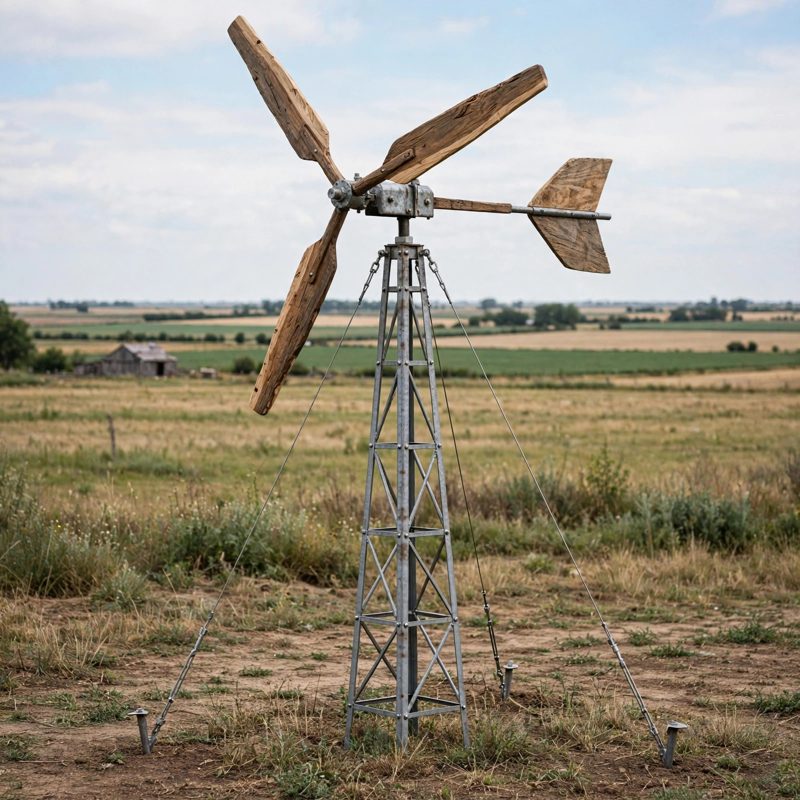
Not a standard off-grid kit. This is the top-of-the-line, above-and-beyond rebuild of the classic home wind turbine - safer by design, with every safety and performance claim below naming a real feature drawn into the plan itself.
THE BUILD: an 8 ft diameter (96 in) 3-blade carved-wood rotor driving a home-built axial-flux permanent-magnet alternator (24 N42 magnets on two 12 in steel rotors, 9-coil cast stator), on a 40 ft guyed tilt-up tower - lowest blade tip 36 ft - charging into your existing 24V or 48V battery bank. All head work happens on the ground; the tower tilts down to you.
HONEST WATTS, WITH THE PHYSICS PRINTED: wind power rises with the cube of wind speed, and this plan shows the math two ways. Expect about 55 W at 10 mph, 190 W at 15 mph and 450 W at 20 mph, furling-capped near 600 W above about 25 mph. A mandatory site worksheet (average wind speed, cube-law rows, your load list) decides whether your site pays BEFORE you spend a dollar - below a 9-10 mph open-site average, the plan tells you to buy solar instead.
SAFETY SYSTEMS ORDINARY KITS LEAVE OUT, ALL DRAWN IN: (1) FURLING TAIL - offset yaw axis and a 24 x 30 in (5.0 sq ft) vane turn the rotor out of the wind automatically above about 25 mph, so overspeed protection works while you sleep. (2) DUMP LOAD SIZED 1.5x - a diversion controller plus a 1,000 W dump element (against a 600 W maximum output) means a full battery on a windy night can never unload the turbine or cook the bank; the open-dump failure mode is named, alarmed and put on a monthly continuity check. (3) THREE WAYS TO STOP - furling, a labelled 3-phase shorting brake switch (its honest limits stated: it will not stop a rotor in a gale), and tilt-down. (4) TILT-UP TOWER - 8 guys at two levels (45 ft uppers to 38 ft, 31 ft lowers to 20 ft, anchors 24 ft out, every length derived by Pythagoras and checked against a scale drawing), hinge base, gin pole and winch raising with pause points and a clear fall zone. (5) LIGHTNING - 8 ft ground rod bonded to the mast and a surge arrester on the DC line.
EVERY MEASUREMENT VERIFIED TWO WAYS: swept area 50.27 sq ft (imperial AND metric, cross-checked); the power table by formula AND by cube-law scaling; guy lengths by Pythagoras AND scale drawing; wire voltage drop by resistance math AND drop tables (worked example: 6 AWG at 48V over 100 ft = 1.5% drop; the 24V case computed too, with the 2 AWG fix). Every structural bolt is bite-checked (blade bolts: full nut engagement with 0.50 in protrusion through the clamped root) and every load path traced to bearing - head ON tower-top plate, tower ON its pad, blades clamped between plates.
BEGINNER-FIRST, IN DEPTH: terms defined at first use, a practice section (blade carve, magnet handling, test coil, crimp pull-test) before the real build, 34 continuously numbered steps, 12 labeled diagrams - one at every technique step - a stop-and-check after each of the 6 stages, mistake fixes for every stage, sourcing with exact order specs and a good/better path, spares kit, printed test schedule, and a final checklist.
You receive: the PDF plan only (digital download, no physical product ships) with materials list, cut/layout dimensions, full verification section, winding table for 24V and 48V, and commissioning log steps. Full build plans and material list in the TheWorkshopBlueprint website store at theworkshopblueprint.shop.