
Rolling Cyclone Dust Separator Cart Plan - Separator Drum + Vacuum on One Fitted Rolling Base
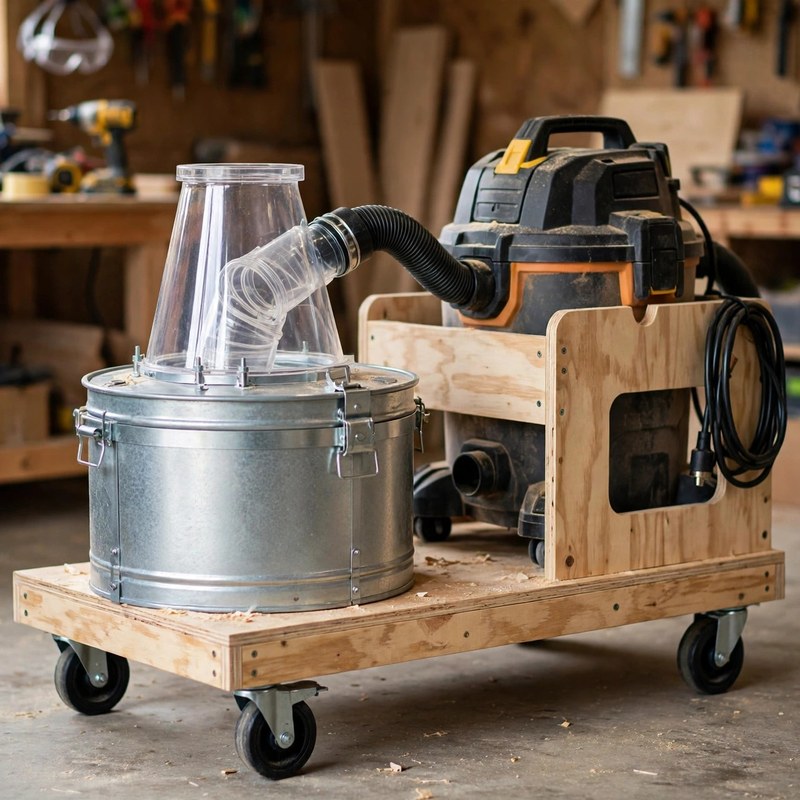
Not a standard off-grid kit - top-of-the-line, above and beyond the old style - safer by design, and every claim below names a real feature drawn into the plan itself.
THE BUILD: a rolling cart, 28 x 40 in footprint with the deck top at 8 in, that carries a cyclone dust separator stacked on its collection drum at the front and the shop vacuum in its own cradle at the rear, so the whole dust-collection point rolls to the tool on one short, fixed hose run. Worked example: an 18 in diameter x 27 in drum, a separator standing 15 in above its lid plate, overall height 50-3/4 in to the top of the inlet. This is one mobile separator station for one vacuum and one hose run - distinct from a fixed ducted dust-collection system: no wall ducting, no blast gates, and no whole-shop claim is made anywhere in the plan.
HONEST PERFORMANCE - NO INVENTED NUMBERS: this plan publishes no airflow (CFM) figure and no separation-efficiency percentage, because those depend on your vacuum, your cone, your hose length, and your filters. Instead it fits the two common hose systems - 4 in dust-collection hose and 2-1/2 in vacuum hose - through a measure-yours worksheet: you record your separator's actual inlet and outlet port outside diameters and choose the hose and adapters that truly fit them, and the build ends with a seal check run with your own vacuum (blocked-inlet pull-down, tissue test at every joint) - a measured seal on your equipment instead of a percentage claimed for someone else's.
SAFER BY DESIGN - THE SEPARATOR-CART FAILURES ARE DESIGNED AGAINST: (1) TIPPING is answered with geometry and a printed gate: a full 28 x 40 in footprint, drum and vacuum both standing low on the deck, two locking casters at the front, a push crossbar at 37-1/2 in, and tip math worked in the open - 109 lb loaded, centre of gravity at 16.7 in, a 40 degree static tip angle sideways, tipping push of about 30 lb at the very top versus about 41 lb at the crossbar - ending in the printed rule: push at the crossbar or lower, never by the separator, and lock the casters before hose work. (2) A LEAKING LID SEAL is designed out: a rigid 3/4 in plywood lid plate (Baltic birch on the better path) with a continuous foam gasket ring and a four-bolt flange pattern tightened in a cross pattern, gated by the running seal check - not a flexing plastic lid. (3) DRUM AND VACUUM WALKING OR SLIDING is answered with dimensioned cradles fitted from the worksheet (bin opening = your drum base + 1 in; vacuum opening = your vacuum base + 1 in; 19 x 19 in and 18 x 18 in in the example) plus a retention strap over the lid plate. (4) UNDERSIZED CASTERS are answered with a rating check printed in the plan: 150 lb rated casters against a computed 27 lb per caster at full design load (factor about 5.5), and 55 lb per caster in the two-caster threshold case. (5) FINE DUST is answered plainly: respirator and upwind outdoor emptying are labelled on the cart itself, and the plan states what never goes into the system - hot ash, sparks, liquids, or fuel-soaked debris.
EVERY MEASUREMENT VERIFIED TWO WAYS - THREE FULL CHECKS PRINTED IN THE PLAN: (1) FOOTPRINT AND HEIGHT STACK: frame width by parts (25 + 1-1/2 + 1-1/2 = 28 in) and by the cradle layout (bin cradle outside depth 20-1/2 + vacuum cradle 19-1/2 = the full 40 in deck depth), and the height stack by parts (caster mount 3-3/4 + rail 3-1/2 + deck 3/4 = deck top 8 in; + drum 27 + lid 3/4 + separator 15 = 50-3/4 in) checked by a tape on the finished loaded cart. (2) STABILITY: total weight by item (30 + 6 + 6 + 7 + 8 + 22 + 30 = 109 lb) and by grouping (empty cart 49 + loaded drum system 38 + vacuum 22 = 109 lb), centre of gravity by weighted moments (1,818 in-lb / 109 lb = 16.7 in), then tip resistance by static angle AND by push force - both routes printed with the formula so a taller stack can be recomputed. (3) DRUM VOLUME AND CASTER LOAD: drum cross-section 254.5 sq in x 23 in fill height = 5,853 cu in = 25.3 gal usable, cross-checked as about five 5-gallon bucketfuls to the fill line; contents cap set at 30 lb under the 33.9 lb brim-full figure; caster load 109 / 4 = 27 lb each. Every screw and bolt in the build is reach-checked in the plan, including the flange bolts specified at 1/4 x 2 in because a 1-1/2 in bolt leaves only 1/2 in for the nut stack.
BEGINNER-FIRST, IN DEPTH: every term defined at first use (cyclone separator, cradle, gasket, flange, port OD, bite, bearing, centre of gravity), a practice-first stage proving the caster mount, the cradle fit around your own drum, and the gasket seal on scrap, 22 continuously numbered steps in 6 stages, 12 labelled diagrams placed at their steps, a stop-and-check after every stage (frame diagonals within 1/8 in, deck taped at height, seal check passed with the vacuum running, loaded roll test over a threshold strip, stability gate at the crossbar, one-person emptying drill), mistake fixes (a whistling lid, a walking drum, a chattering caster, a hose pulling off, a fast-loading filter, a tippy feel, a vacuum that will not sit with its cord), a good/better materials path (sanded plywood and rated casters vs Baltic birch lid plate, polyurethane-tread casters, and a steel drum - the upgrades that matter at the seal and the roll), and sourcing with exactly what to order including the plywood yield check and the cleat-stock correction (two 8 ft pieces, not one - the arithmetic is printed). The separator cone, drum, hoses, and vacuum are separate purchases, estimated openly in the plan and never buried in the cart price.
You receive: the PDF plan only (digital download, no physical product ships) with cut list, materials list, measure-yours worksheet, full two-way verification section, and final completion checklist. Full build plans and material list in the TheWorkshopBlueprint website store at theworkshopblueprint.shop.