
Freestanding Bird Feeder Pole Station Plan - Squirrel Baffle + 4 Hanging Arms, Concrete Pier
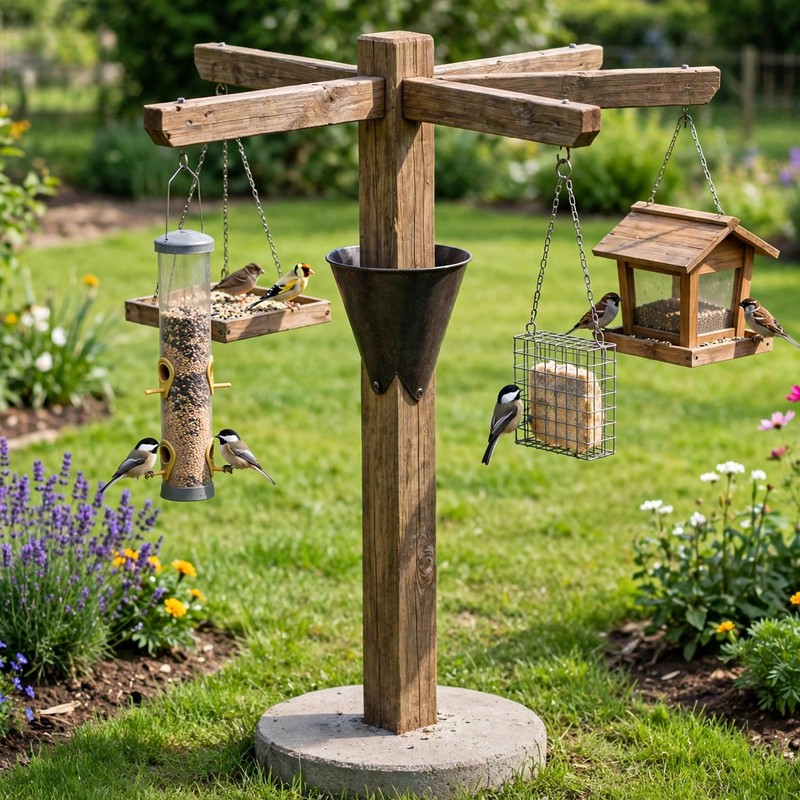
Not a standard off-grid kit - top-of-the-line, above and beyond the old style - safer by design, and every claim below names a real feature drawn into the plan itself.
THE BUILD: a freestanding feeder station on one pressure-treated 4x4 post - 90 in above ground, two 36 in crossarms forming a plus with four hanging points, and a sheet-metal cone baffle you lay out, cut, and rivet yourself (a purchased 4x4-post baffle is the stated better-path alternative). Feeders up to 16 in tall hang with their bottoms at 60-1/4 in or higher.
THE WIND MATH IS PRINTED, AND IT IS HONEST: at a 70 mph gust the four feeders present about 2.2 sq ft of sail and the overturning moment at ground line works out to about 174 ft-lb - while the concrete pier's dead weight alone resists only about 140 ft-lb. The plan says so in plain words, and designs the difference in: a 12 in diameter pier poured 30 in deep against undisturbed soil (with the hole rules that make the soil count), a 30 in earth auger anchor REQUIRED in loose, sandy, or filled soil or on exposed sites, and a standing rule to take feeders down ahead of 60 mph-plus storms. A surface ballast base is checked in the plan and rejected with its numbers shown.
THE SQUIRREL GEOMETRY IS A SYSTEM, NOT A PROMISE: baffle top at 58 in, lowest feeder bottom at 60-1/4 in, both above a squirrel's roughly 4 ft vertical leap; hooks at 16 in radius hang feeders 3 in clear of the cone's widest edge; and Step 4 makes you tape at least 10 ft from every launch point - tree, fence, or roof - before you dig. The plan's word is 'deters,' never 'squirrel-proof': a squirrel with a launch point beats any baffle, so the plan removes the climb route and the jump route and tells you how to read the evidence if one still gets through.
SAFER BY DESIGN - THE STATION FAILURES ARE DESIGNED AGAINST: (1) BLOW-OVER is answered with the pier, the soil rules, and the conditional auger anchor above. (2) ARMS PULLING OFF are answered with 3/8 in through-bolts - 5.0 in of wood path, 5-1/2 in bolt, washers both sides, reach-checked in the plan; a 5 in bolt is checked and rejected. Arm bending at twice a typical feeder's weight works out to about 47 psi against roughly 875 psi working strength - an 18x margin, shown. (3) A USELESS LOW BAFFLE is answered with the 58 in collar height, gated by tape at mounting. (4) DIRTY FEEDERS are answered with a built-in hygiene routine: feeders lift off in seconds, cleaning and a 1-to-9 bleach disinfection every two weeks, hulls raked, and all feeders down for two weeks if a sick bird is found. No disease-cure claims - the published routine, designed for.
EVERY MEASUREMENT VERIFIED TWO WAYS: post height by subtraction and by the above-ground stack; arm reach by centreline arithmetic both directions; concrete by pier volume (1.75 cu ft net) and by the bag (3 x 80 lb); the cone's flat pattern by slant geometry and by arc length (81.6 in vs 81.7 in); the collar opening against the post's own diagonal (5-1/2 in vs 4.95 in).
BEGINNER-FIRST, IN DEPTH: every term defined at first use (baffle, pier, auger anchor, overturning moment, frustum, launch point, bite), a practice-first stage (the through-bolt joint, the cone pattern proven in cardboard, the hook bite test with a water jug), 28 continuously numbered steps in 6 stages, 12 labelled diagrams placed at their steps, a stop-and-check after every stage, mistake fixes (a leaning post, a launched squirrel, a swinging feeder, a loose arm nut, moldy seed), a good/better materials path, and sourcing with the yield math for every board, bag, and sheet.
You receive: the PDF plan only (digital download, no physical product ships) with cut list, materials list, full two-way verification section, and final completion checklist. Full build plans and material list in the TheWorkshopBlueprint website store at theworkshopblueprint.shop.